Compiled in2.4s11 sourcesSAP, Gmail, Google Drive, Slack, Confluence+6





€38,400 this year. We signed two years ago at €31,200. Most of the increase comes from headcount growth and a compliance add-on added last March.
From what happened this morning to why a decision was made three years ago, Hartlib brings the history of an entire company into one conversation.

A useful answer may depend on what happened across teams, tools, people, and time. Hartlib brings that history together before answering.
Which rollout plan is approved for the October launch? The September 4 plan is still the approved version, with launch scheduled for October 22. A September 6 draft proposes October 15 after the customer asked for an earlier date, but I found no approval for that change. The latest Operations review still references October 22, so that is the date to work from.
Move forward without tracking down who remembers, interrupting their work, or scheduling a catch-up just to piece together what already happened.
Start with the relevant facts already in view, so less time goes into searching, checking, and rebuilding context before deciding what to do.
Reuse earlier decisions, attempts, outcomes, and lessons instead of rediscovering them, so each new problem starts further ahead than the last.
04 · Current state
Plans move, approvals change, and later requests do not always replace what was already agreed. Hartlib follows the history to show what applies now.

05 · Experience
Bring earlier attempts, decisions, and outcomes into the problem in front of you. Hartlib shows what helped before, what failed, and what is different this time.
Yes. Two earlier launches slipped after final assets arrived too late. Moving asset approval one week earlier prevented the same issue on the following releases.
This time, the assets are already approved. Translation review is the remaining blocker.
06 · Evidence
Every conclusion stays connected to the records behind it. Open the source, check the evidence, and see where the answer is confirmed, inferred, conflicting, or still unresolved.
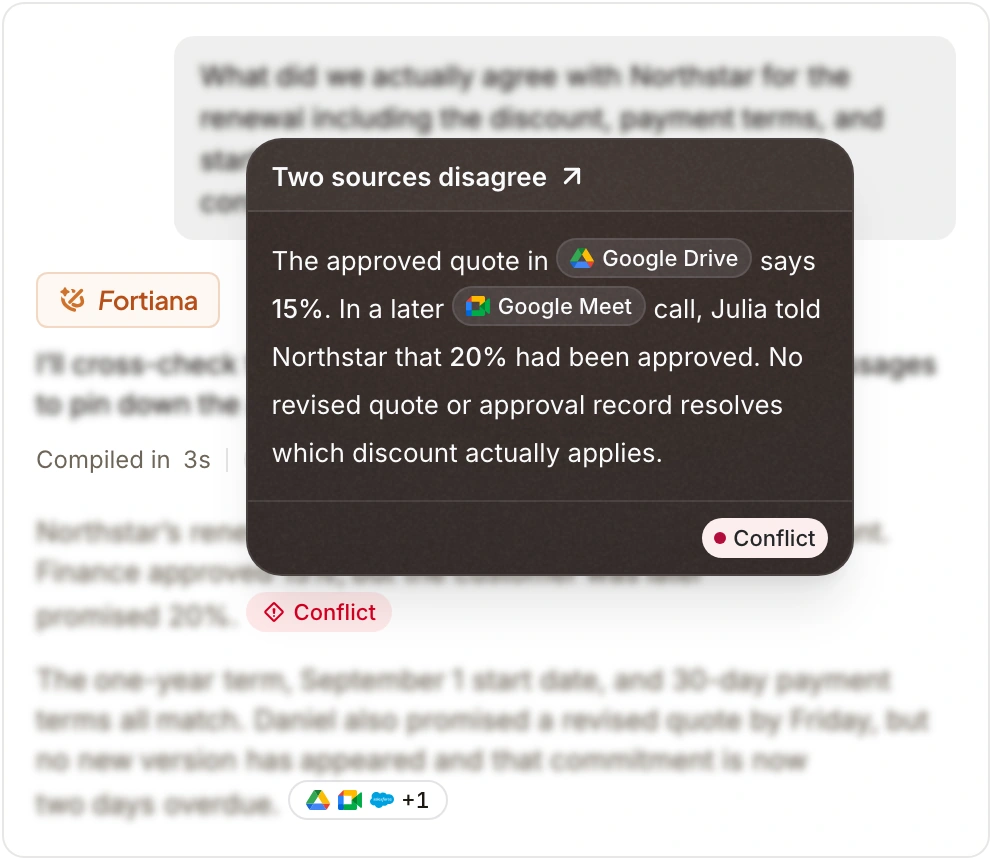
Commitments stay linked to who made them, when, and the context around them, so important follow-ups do not get lost between conversations and tools.
Step into ongoing work with the decisions already made, the issues still open, and the commitments that still need to be kept.
Connect the tools your team already uses and bring their existing history into Hartlib. Conversations, documents, projects, and decisions can become usable memory from the start, not just from the day you connect it.
| Authentication | Actions | ||||
|---|---|---|---|---|---|
Slack | Ready | OAuthConnected | 14.6k | 2 min ago | |
Google Drive | Syncing78% | OAuthConnected | 38.4k | Now | |
Jira | Ready | API tokenExpires in 24 days | 12.1k | 4 min ago | |
ChatGPT | Ready | Compliance APIExpires in 18 days | 6.7k | 3 min ago | |
GitHub | Ready | GitHub AppConnected | 31.6k | 11 min ago | |
Salesforce | Paused | OAuthReconnect required | 8.2k | 6h ago | |
Microsoft Teams | Ready | OAuthConnected | 21.2k | Now | |
Notion | Ready | OAuthConnected | 18.9k | 2 min ago | |
Dropbox | Ready | OAuthConnected | 9.4k | 4 min ago |
A different kind of scalable AI memory, built on deterministic language compilation instead of per-record LLM extraction.
Hartlib can draw on shared history without flattening the access boundaries around it. Each answer reflects only the information the person asking is allowed to use.

Start in minutes.
Sign up, connect your tools, and invite your team. We manage the infrastructure, models, scaling, and updates for you.

Inside your environment.
Run Fortiana in your private cloud, VPC, or data center. Your data and models stay inside your infrastructure, fully under your control.

Built for full isolation.
Fortiana runs fully offline, with no internet connection. Local models and dedicated hardware let it run in a fully disconnected environment.




 Google Meet

 Workday